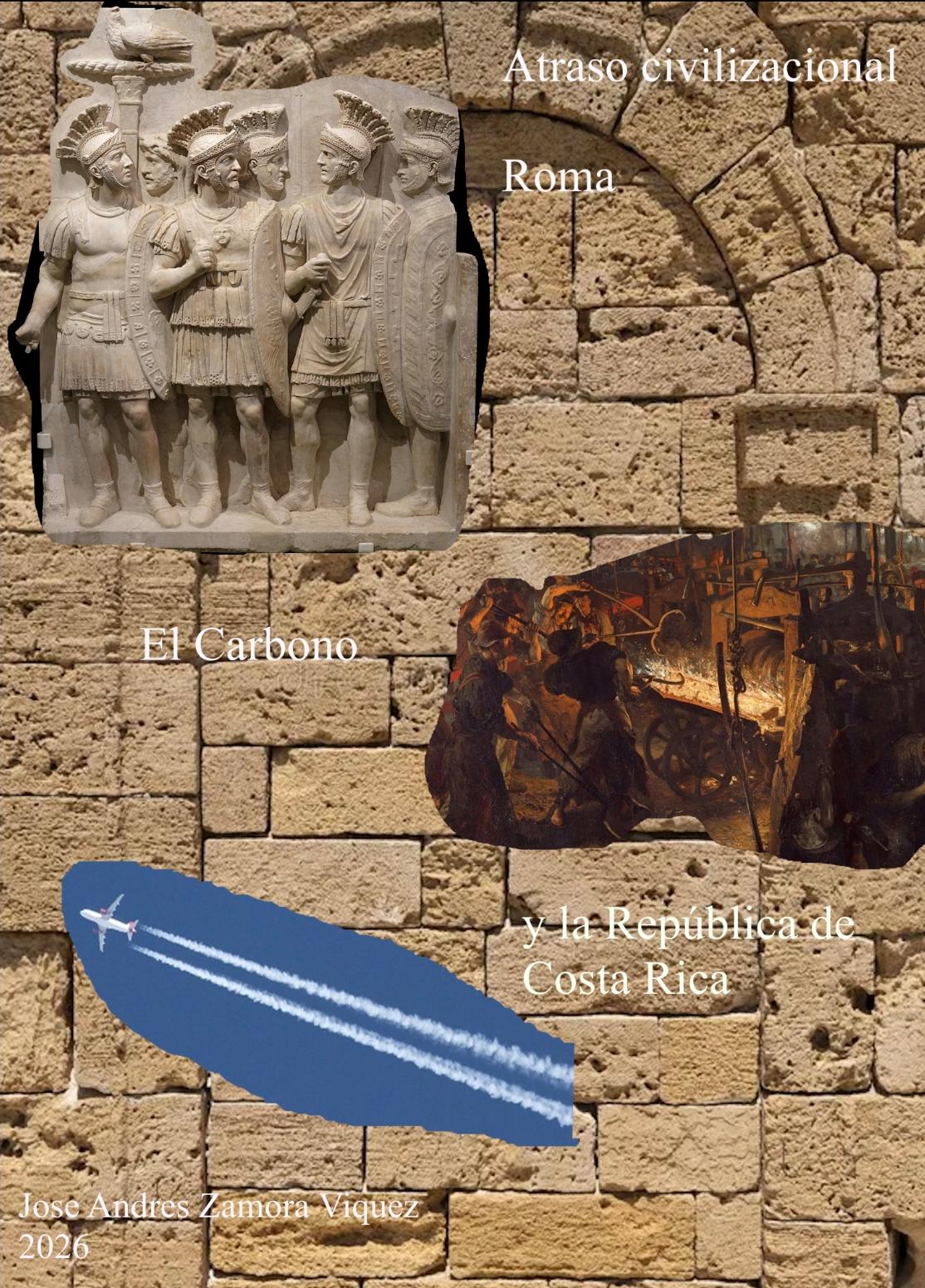
Atraso civilizacional: Roma, el carbono y la República de Costa Rica
Keywords:
History, Renewable energy, Termination Shock, Costa Rican Judicial FrameworkAbstract
A historical argument is based on the theory that civilizations systematically generate invisible damage as byproducts of their greatest achievements, and that each iteration of this pattern not only repeats itself but intensifies by magnitudes. From Roman lead that contaminated an empire, to industrial carbon that destabilized a planet, to solar geoengineering that threatens to lock humanity into atmospheric dependency with no safe exit. The paper proposes civilizational lag as a formal concept to describe the structural gap between technological consequence and institutional response and argues that the pattern ends in a termination shock; the moment when halting intervention becomes as catastrophic as the original problem. Costa Rica, as the protagonist of a dystopian future, a small state that is responsibly decarbonizing, built a public energy model based on clean hydrology and now finds itself doubly exposed to instabilities it did not cause and interventions it cannot control. A real world example of the price civilizational lag pays to those who have acted correctly.
Downloads
References
Arrhenius, S. (1896). On the influence of carbonic acid in the air upon the temperature of the ground. *The London, Edinburgh, and Dublin Philosophical Magazine and Journal of Science, 41*(251), 237–276.
Asamblea Legislativa de Costa Rica. (2026). *Ley de Armonización del Sistema Eléctrico Nacional (Expediente N.º 23.414).*
Bonneuil, C., & Fressoz, J.-B. (2016). *The shock of the Anthropocene: The Earth, history, and us*. Verso.
Foote, E. N. (1856). Circumstances affecting the heat of the sun's rays. *American Journal of Science and Arts, 22*(66), 382–383.
Hiar, C., & Mathiesen, K. (2025). Global cooling startup raises $60M to test sun-reflecting technology. *E&E News by POLITICO*.
Instituto Costarricense de Electricidad. (2026). *Informe anual de generación eléctrica 2025*. ICE.
Martínez, G. (2026, 26 de mayo). Diputados votan en primer debate proyecto de armonización eléctrica. *CRHoy*.
McConnell, J. R., Wilson, A. I., Stohl, A., Arienzo, M. M., Chellman, N. J., Eckhardt, S., Thompson, E. M., Pollard, A. M., & Steffensen, J. P. (2018). Lead pollution recorded in Greenland ice indicates European emissions tracked plagues, wars, and imperial expansion during antiquity. *Proceedings of the National Academy of Sciences, 115*(22), 5726–5731.
McConnell, J. R., et al. (2022). Pervasive lead pollution and cognitive impact in ancient Rome. *Proceedings of the National Academy of Sciences*.
McFarland, M. J., Hauer, M. E., & Reuben, A. (2022). Half of US population exposed to adverse lead levels in early childhood. *Proceedings of the National Academy of Sciences, 119*(11), e2118631119.
Parker, A., & Irvine, P. J. (2018). The risk of termination shock from solar geoengineering. *Earth's Future, 6*(3), 456–467.
Pliny the Elder. (1938). *Natural history* (H. Rackham, Trans.). Harvard University Press. (Obra original publicada ca. 77–79 d. C.).
The Tico Times. (2024, abril). Costa Rica faces historic drop in renewable energy production.
Trisos, C. H., Amatulli, G., Gurevitch, J., Robock, A., Xia, L., & Zambri, B. (2018). Potentially dangerous consequences for biodiversity of solar geoengineering implementation and termination. *Nature Ecology & Evolution, 2*, 475–482.
United Nations. (2015). *Paris agreement*.
U.S. Government Accountability Office. (2026). *Climate intervention: Strengthening federal oversight of solar geoengineering*.
Vitruvius. (1999). *Ten books on architecture* (I. D. Rowland, Trans.). Cambridge University Press. (Obra original publicada ca. siglo I a. C.)